Required Ritual of Islam: Hajj

2016 Ramadan GraphicHajj, the fifth pillar of Islam, is an annual pilgrimage to Mecca. It is a mandatory requirement for adult Muslims to make the pilgrimage at least once in their lifetime if they are physically and financially able to make the journey.

The pilgrimage occurs from the eighth to the twelfth day of the Islamic month of Dhu al-Hijjah. This year Hajj will be held from Friday, September 9 through Wednesday, September 14, 2016. If a Muslim visits Mecca at any other time of year, the ritual is called “umrah” or the lesser pilgrimage, but umrah does not remove the requirement of Hajj.

The Hajj is one of the largest gatherings of people in the world with more than two million Muslims from over 183 countries making Hajj each year. The pilgrims follow a route that Muhammad once walked, but they believe they are ultimately tracing the footsteps of Abraham and Ishmael.

Pilgrims walk 14.4 km (8.95 miles) to the plain of Arafat, passing Muzdalifah a few miles east of Mecca where it is believe Muhammad delivered his last sermon. There they spend the day praying and reading the Qur’an. Afterwards they walk 9 km (5 miles) back to Muzdalifah where they spend the night.

The next day they collect small pebbles and carry them to Mina where they throw the pebbles at three white pillars. This day’s ritual is called the Stoning of the Devil at Jamaraat. There have been deadly stampedes during this part of the journey. Despite improvements in the route by the Saudi Arabian government in recent years, last year 2,236 pilgrims were killed in a crowd crush. Because of this incident Iran has announced that it will not send pilgrims to Saudi Arabia this year. Last year Iran reported that 464 Iranians were killed in the crowd crush.

Traditionally following the stoning of the devil, pilgrims sacrifice an animal to symbolize the ram Abraham sacrificed instead of his son, however more recently pilgrims are required to purchase a “sacrifice voucher” to have the sacrifice performed for them.Hajj Grand Mosque

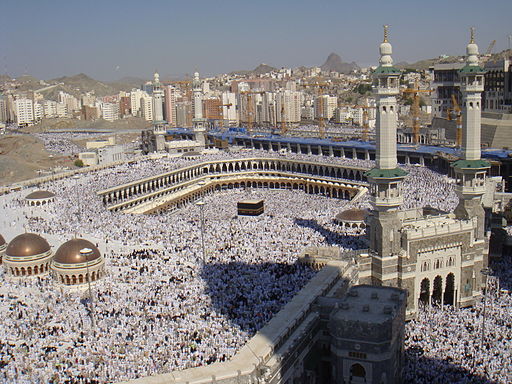
Pilgrims return to Mecca and go to the Grand Mosque where the circle the Ka’aba counter-clockwise seven times. The Ka’aba is a cube shaped building in the center of the Grand Mosque in Mecca that Muslims believe was built by Abraham and his son Ishmael. The Black Stone is in the eastern cornerstone of the building. Muslims believe Muhammad himself set the Black Stone in its current location five years before he began to receive his revelations. The Grand Mosque has three floors that each have a capacity of 750,000 people, however because of the volume of people circling the Ka’aba can take hours.

Other Hajj rituals include running back and forth between the hills of Al-Safa and Al-Marwah and drinking from the Zamzam Well. The Grand Mosque now encompasses the route so it is traversed by air-conditioned tunnels with special sections for walkers, runner and disabled pilgrims.

Although not required after the end of Hajj, many pilgrims will extend their trip and travel to Medina visiting the Mosque of the Prophet and location of the tomb of Muhammad.

Prayer Point:

Christianity is the only religion where God loves men and women so much that He reaches down to redeem man, rather than man trying to perform works or rituals to reach God. Pray that Muslims will have a revelation of His love.

Photo By Al Jazeera English (Al-Haram mosque) [CC BY-SA 2.0 (http://creativecommons.org/licenses/by-sa/2.0)%5D, via Wikimedia Commons

Required Rituals of Islam

2016 Ramadan GraphicThe five pillars of Islam are five basic acts considered mandatory by Muslims. These five pillars are found in the hadith. Today we will look at the first two pillars. A list of the pillars are found in Sahih al-Bukhari, Volume 1, Book 2, Number 8:

Allah’s Messenger said: Islam is based on (the following) five (principles):

  1. To testify that none has the right to be worshipped but Allah and Muhammad is Allah’s Messenger.
  2. To offer the (compulsory congregational) prayers dutifully and perfectly.
  3. To pay Zakat (i.e. obligatory charity) .
  4. To perform Hajj. (i.e. Pilgrimage to Mecca)
  5. To observe fast during the month of Ramadan.

The first pillar is a confession of faith called the shahada. The confession, “La ilaha illa Allah, Muhammadur rasoolu Allah” is to be declared in Arabic, and must be said with conviction and an understanding of its meaning. The first part, “there is no god but Allah” is declaring that only Allah can be worshipped and that Allah has no partner or son. The second part declares the Muhammad is the messenger of Allah. It should be noted that you do not become a Muslim by simply pronouncing the words. The oral declaration is a reflection of belief that is held in one’s heart.

The complete shahada does not appear in the Qur’an. It is actually found in Sura 9:31, and in Sura 33:40. As soon as a baby is born into a Muslim family, these words are whispered into his ears, and if possible a Muslims is encouraged to repeat the words as he is dying.

The second pillar is salat. Salat consists of five daily ritualistic prayers. Personal prayer or supplication by Muslims is called dua. The salat prayers are named according to the prayer times: Fajr (dawn), Dhuhr (noon), ‘Asr (afternoon), Maghrib (evening) and Isha (night). The prayers are recited while facing the direction of the Kaaba in Mecca.

Salat has a set of positions while reciting certain verses, phrases or prayers. The worshiper begins by standing, but as he repeats the prayers he bows, prostates and concludes while sitting on the ground.

Before prayer, Muslims must perform wudu or abulution to make sure they are clean from any physical impurities. These steps include washing your hands, inhaling water into the nose, washing the face, lower arms, head, ears, and feet.

As Christians, we know that God is our Father who desires to fellowship with His children just as they are. Because of Christ’s sacrificial death on the cross we can each approach God without rituals. Hebrews 4:16 says, “Let us therefore come boldly to the throne of grace, that we may obtain mercy and find grace to help in time of need.”

Prayer Point:

Much of the worship of Allah by Muslims is ritualistic. Pray they will have a revelation of the love of our Heavenly Father who desires a personal relationship rather than rituals.