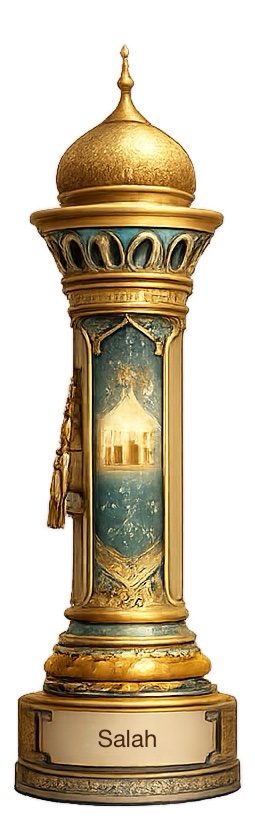
In Islam, Salah (also spelled Salat) is the second of the Five Pillars and one of the most visible expressions of the Muslim faith. It consists of five formal prayers performed at specific times throughout the day: Fajr (dawn), Dhuhr (noon), ‘Air (afternoon), Maghreb (just after sunset), and Isha (night).
Before each of the five daily prayers, the Adhan (call to prayer) is proclaimed. Traditionally announced from the minaret of a mosque by a muezzin, it may also be broadcast through speakers. The Adhan is both a public declaration of faith and an invitation to worship.
The Adhan contains a series of specific phrases in Arabic that declare core beliefs of Islam. The phrases are repeated in a melodic, rhythmic manner declaring:
Allahu Akbar (God is greatest.)
Ashhadu an la ilaha illa Allah (I bear witness that there is no god but Allah.)
Ashhadu Anna Muhammadan rasul Allah (I bear witness that Muhammad is the messenger ofAllah.)
Hayya ‘ala as-salah (Come to prayer.)
Hayya ‘ala as galah (Come to success.)
Allahu Akbar (God is greatest.)
La ilaha illa Allah (There is not god but Allah.)
For the dawn prayer (Fajr) an additional line is included which says, “As-salatu khayrun min an-nawm” (Prayer is better than sleep.)
Before performing Salah, Muslims must prepare by performing a ritual washing. This ritual called wudu is done in a specific order: Wash the hands; rinse the mouth; inhale water into the nose; wash the face; wash the arms up to the elbows; wipe over the head and ears; and wash the feet. Wudu represents intentional preparation and respect before standing in prayer.
Finally, wherever Muslims are in the world, they face toward the Kaaba in the city of Mecca as they pray. Facing this direction symbolizes unity, as millions of Muslims pray toward the same focal point each day.
Salah is a structured and disciplined form of prayer. During prayer, Muslims recite passages from the Qur’an in Arabic and repeat specific phrases of praise and devotion. The prayer follows a set pattern of movements. The worshiper begins standing, then bows, prostrates with his forehead touching the ground, and concludes seated.
Together, the Adhan, wudu, and Salah form a repeated cycle woven into the everyday life of a Muslim. In addition to the five prescribed daily prayers, Muslims also practice Dua, which is personal supplication. Unlike Salah, Dua is informal and may be spoken at any time and in any language.
Through this daily rhythm — hearing the call, washing in preparation, standing, bowing, and prostrating — Muslims perform their obligatory prayers to Allah.

 Best Current News
Leave a comment